Friday, 11 February 2011

Tinamous


Add caption

Description
Tinamous are slim and compact birds, with a little head and a little slim bill, that is down curving. The littlest kind, the Dwarf Tinamou, is about 43 g (1.5 oz) and 20 cm (7.9 in) lengthy. The biggest tinamou, the Old Tinamou, weighs 2.3 kg (5.1 lb) and measures up to 53 cm (21 in) lengthy. They have very little wings, but unlike extra ratites, they can fly, albeit weakly. They have three onward-facing toes, and their rear toe is higher and both retrogressed or missing. Their tail is little and at time uknown be rear coverts, and a few tinamous have crests. Also, unlike extra ratites, they have a clean gland. Plumage does not change among sexes, except a few that have brighter females.
Behavior
Tinamous are seldom seen, but often heard within their variety. They favor to walk or run and will fly seldom in risky situations. When they have pooped all extra techniques counting hitting in burrows, they may fly. Their technique is a flicker of wing-beats follow by a lengthy glide, follow by an extra split open of wing-beats. Although a few kind are quite common, they are shy and secretive. A little number of kind live in more open, green country, but even these are wary. Tinamous have a wide selection of calls, but one thing they have in common is their good looks.

Reproduction
Tinamous put more than a few eggs in a earth nest lined with grass and plants, and the male will incubate the eggs. He will go away the nest to give food to, and he may be spent from 45 minutes to 5 hours. Typically, the male will not cover up the eggs when he trees to feed, even however the eggs are not disguised. In most tinamou kind, the male is polygamous and the female is polyandrous. The eggs are delightfully painted in a only colour and have a hard polish like chinaware. The young are precocial, and can run just about as quickly as they give forth. Scientist believe that they are self-enough within 20 days.

Ostriches


Introduction:
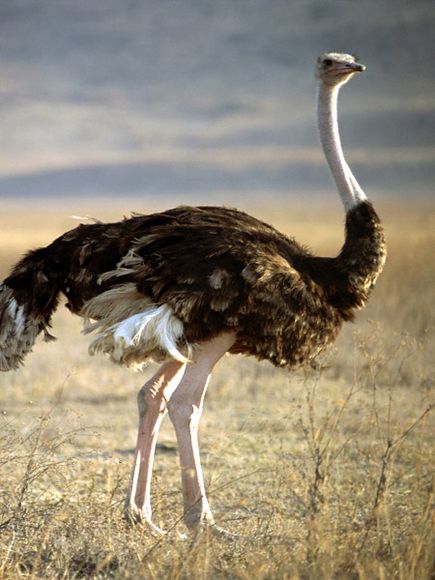
Ostriches develop into sexually older when they are 2 to 4 years old; females older about six months previous than males. The kind is iteroparous, with the mate time beginning in March or April and conclusion for a time by September. The mate practice differs in dissimilar environmental region. Territorial males typically jeer and use added sound to state success above a harem of two to seven hens. The victorious male will then be allowable to variety with all the females in an area, but will single form a match up union with the leading female.
The cock performs with his wings, broken wing beats, until he attract a helper. They will go to the mate region and he will uphold solitude by heavy away all intruders. They browse until their behavior is synchronized, then the feed become derived and the procedure takes on a ritualistic manifestation. The cock will then excitedly flap alternate wings again, and starts poking on the earth with his check. He will then violently flutter his wings to representatively clear out a nest in the filth. Then, while the hen runs encircle roughly him with lower wings, he will breeze his head in a twirl action. She will drop to the land and he will mount for copulation.
Ostriches are oviparous.
The females will arrange their fertilized eggs in a single communal nest, a simple pit, 30 to 60 centimetres (12–24 in) deep and 3 metres (9.8 ft) wide, scraped in the ground by the male. The foremost female lays her eggs first, and when it is time to cover them for incubation she junk more eggs from the weaker females, parting about 20 in most bags. Ostrich eggs are the biggest of all eggs (and by extension, the yolk is the biggest solitary cell, though they are actually the smallest eggs comparative to the size of the adult bird.On average they are 15 centimetres (5.9 in) long, 13 centimetres (5.1 in) wide, and weigh 1.4 kilograms (3.1 lb), over 20 times the weight of a chicken egg. They are silky cream-coloured, with thick bullets patent by little depths. The eggs are incubate by the females by day and by the males by night. This uses the coloration of the two sexes to escape recognition of the nest, as the plain female blend in with the rub down, while the black male is almost untraceable in the night. The incubation period is 35 to 45 days. Typically, the male defend the hatchlings and teach them to feed, even though males and females assist in education chicks. The endurance speed is low for the hatchlings, with an regular of one per nest current to maturity. Predators comprise hyenas, jackals, various birds of quarry, and vultures.
Ostriches reared entirely by humans may not through their courtship behavior at other Ostriches, but toward their person keeper.

Rheas


Description
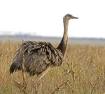
Rheas are large, flightless birds with gray-brown plumage, lengthy legs and lengthy necks, alike to an ostrich. Males of R. Americana can reach 1.50 metres (4.9 ft), and weigh up to 40 kilograms (88 lb). Their wings are big for a flightless bird and are extend while running, to act like sails. Different most birds, rheas have only three toes. Their tarsus has level tableware on the front of it. They too amass urine discretely in an growth of the cloacae.
Personality and flock
Rheas be apt to be still birds with the omission life form when they are chicks or when the male is looking for a mate. During the non-breeding time of year they may form flocks of among 10 and 100 birds, even if the smaller Rhea forms lesser flocks than this. When in risk they flee in a zigzag route, utilize first one wing then the other, comparable to a wheel. For the period of reproduction time of year the flocks fracture up.

Duplicate

Rheas are polygamous, with males courting among two and twelve females. After mate the male builds a nest, in which each female lays her eggs in turn. The nest consists of a easy scuff in the view, craggy with grass and plants. The male incubate from ten to sixty eggs. The male will employ a bait structure and place a few eggs exterior the nest and forfeit these to predators, so that they won't attempt to get inside the nest. The male may utilize another subordinate male to hatch his eggs, while he fined another harem to create a second nest. The chicks give forth inside 36 hours of each other. The females, in the meantime, may move on and mate with other males. While helpful for the youthful, the males will arraign at any apparent threats that move toward the chicks counting female rheas and human. The youthful reach full mature size in about six months but do not strain pending they arrive at two years of age.

Trogons

Blue-crowned Trogon
he Blue-crowned Trogon (Trogon circuit) is a genus of bird in the Trogonidae family. It is institute in Argentina, Bolivia, Brazil, Colombia, Ecuador, Paraguay, and Peru. Their ordinary habitats are subtropical or steamy humid plain forest and greatly dishonored previous forest.
Variety in South America, Amazon Basin
The Blue-crowned Trogon's variety in South America is the southwestern and southeastern quadrants of the Amazon Basin with the northern bound being the Amazon River. The series continue clear of the Amazon Basin south to northern Argentina and Paraguay, and eastwards to eastern coastal Brazil as far south as northern Espírito Santo situation; a third of the variety array is external the Amazon Basin.

Trogon is a kind of next to passerine birds in the trogon family. Its members occur in forests and woodlands of the Americas, range from southeastern Arizona to northern Argentina
. Trogon (species)
They have big eyes, stout captivated bills, small wings, and lengthy, squared-off, powerfully graduate tails; black and white tail-feather markings form characteristic pattern on the base. Males have ornately tinted tinny plumage, clanging on the upperparts. Although countless have brilliantly coloured naked eye-rings, they require the colorful patch of bare facial hide in their African counterparts, Apaloderma. Females and youthful are duller and sometimes hard to recognize in the field.[ Eggs are white or bluish-white, unlike the light blue eggs of quetzals. See the family account for additional facts.
trogon,  any of about 35 bird kind common to tepid region. Trogons, who compose the family of Trogonidae, have the belly light red to yellow in dissimilarity with the dim chest and upperparts. In Africa and America, males are sparkling over; those of Asia need the gloss but have a touch of pink or red on the head, chest, rump, or tail. Among the best-known type of the trogon family are the quetzals (kind Pharomachrus).

Bushtits


Habitation:
Bushtits occupy mix coniferous and deciduous areas with shrubby increase. They commonly use housing areas and city parks, as well as youthful coniferous forest with an open awning. They are typically establish west of the cascade. In eastern Washington, they can be create in residential areas, irrigated pasture, orchards, wetlands, and other shrubby areas, even though their variety is very narrow.
Behavior
Extremely societal birds, Bushtits are generally create in flocks of 40 persons or more. When flying from bush to plant, they a lot fly in a sprawling row. In cold weather, the group may crowd mutually at communal roosts to stay balmy. They garner food from foliage and brushwood, often execution upside-down to get at the undersides of grass.
Diet
Bushtits eat for the most part tiny insect and spiders. They as well eat some berries and seeds, and gamely come to suet feeders.

Nesting
There is a few confirmation of communal nesting by Bushtits, but it is partial to southeastern Arizona. Helpers at the nest are generally mature males. During nesting season, flocks break up, and pairs create baggy territory, though they come out to abide other Bushtits inside their territory. Both members of the duo help erect the nest. The nest is an remarkable, woven, execution silo with a hole high up on the region of the nest and a vessel to the nest chamber at the underneath. It can be up to a foot lengthy, and is normally built of spider webs, moss, lichen, and other deposit stuff. Inside, the nest is wizened with set down, fur, and feathers. If the pair is bothered through the untimely stage of nest-building, they will dump the nest and discover a new site, now and then finding a new buddy as well. Both parents keep busy the 4-10 eggs for 12-13 days, from time to time at the equal time. Both litter the youthful and carry them food until shortly after they depart the nest at about 18 days. They commonly raise two brood a year.

Migration Status
Bushtits are regularly enduring inhabitants, though they may shift from steep areas to lesser elevation in frost.

True Tits


Distribution and habitation:
he pendulant tits live in Eurasia and Africa and North America. The species Remiz is just about absolutely Eurasian, range infrequently from Portugal and the tip of northern Morocco during to Siberia and Japan. The biggest species, Anthoscopus, is bring into being in sub-Saharan Africa as of the Sahel during to South Africa. Of the monotypic genus the Verdin lives in barren parts of the southwestern U.S. and northern Mexico, the Fire-capped Tit is bring into being in Southern and Eastern Asia, and the Tit-hylia in eastern and central Africa.
Several genus of pendulant tit are migratory, even though this behavior is only revealed in genus bring into being in Asia and Europe; African genus and the Verdin are actually deskbound. The Eurasian Pendulant Tit is wandering over part of its series, with birds in northern Europe touching south in the winter but birds in southern Europe residual close to their procreation areas. In contrast The Chinese Pendulant Tit and Fire-capped Tit are wholly migrant and assume lengthy aloofness migration.
Most live in open country with trees or scrub, ranging from barren section to swamp to forest, but the Forest Pendulant Tit and the Tit-hillier live in rain forest. They expend most of the year in little flocks (Perris 2003).
Behavior
Insects form the bigger piece of the fast of the pendulant tits, and they are lively foragers. Their lengthy pointed bill is used to query into cracks and pries open holes in classify to find prey. Nectar, seeds and fruits may also be taken seasonally. Their foraging behavior is suggestive of the true tits (Parade), foraging upturned on little twigs, maneuvering brushwood and leaves with their feet in regulate to bug them, and clasping hefty prey stuff with one foot while dismembering them.
The common name of the family reflects the propensity of most genus to create elaborate pear-shaped nests. These nests are woven from spider web, wool and animal hair and soft plant materials and is balanced from twigs and branches in trees. The nests of the African species Arthroscopies are level more involved than the Eurasian Remiss, incorporate a phony entry over the true doorway which leads to a forged meeting room. The true nesting chamber is access by the father opening a unseen flap, incoming and then finishing the flap fasten yet again, the two sides sealing with sticky spider webs.

Of the two genus with abnormal nests, the Verdin builds a domed nest out of sharp twigs and the Fire-capped Tit nests in tree holes that it outline. The eggs are white, with red acne in some genus; the Verdin lay blue-green eggs with red acne. Incubation last about 13 or 14 days, and the nestlings fledge at about 18 days (Perris 2003).

Mourning Dove

Introduction:
He Mourning Dove (Zenaida macroura) is a element of the dove family (Columbidae). The bird is as well call the Western Turtle Dove or the American Mourning Dove or Rain Dove, and previously was known as the Carolina Pigeon or Carolina Turtledove. It is one of the nearly all copious and prevalent of all North American birds. It is as well the foremost game bird, with up to 70 million birds blast yearly in the U.S., both for hobby and for meat. Its aptitude to continue its inhabitants beneath such heaviness stem from its creative breeding: in tepid areas, one duo may lift up to six broods a year. Its sad woo-oo-oo-oo call gives the bird its name. The wings can build a strange whistle sound upon take-off and landing, and the bird is a physically powerful flier, competent of speeds up to 88 km/h (55 mph).
Mourning Doves are light grey and brown and in general quiet in color. Males and females are similar in facade. The genus is generally monogamous, with two squabs (young) per brood. Both parents protect and care for the little. Mourning Doves eat just about completely seeds, but the youthful are fed crop milk by their parents.
The Mourning Dove is intimately connected to the Eared Dove (Zenaida auriculata) and the Socorro Dove (Zenaida graysoni). Some establishment explain them as form a super species and these three birds are now and then secret in the divide species Zenaidura, but the existing organization has them as disconnect genus in the species Zenaida. In adding up, the Socorro Dove has at times been considered conspecific with the Mourning Dove, even though quite a lot of difference in actions, call, and exterior validate severance as two dissimilar genus. While the three variety do form a subgroup of Zenaida, using a separate species would obstruct with the monophyly of Zenaida by making it paraphyletic.