Tuesday, 22 February 2011

Grey-crowned Babbler


The Grey-crowned Babbler (Pomatostomus temporaries) is a genus of bird in the Pomatostomidae family. It is institute in Australia, Indonesia, and Papua New Guinea. Its usual habitat is controlled forest and subtropical or sultry humid flat forests.
Two breed are recognized within Australia and New Guinea.
 This variety occurs within Australia in the state of Victoria, eastern Queensland (counting Cape York), New South Wales and south-eastern South Australia. It is a beggar or chance guest to the Australian Capital Territory. It is also the species alleged to occur within New Guinea.
 This species occurs in Australia within the state of Western Australia, Northern Territory, western Queensland and a little area of northern South Australia.
The breast color is typically used as the characteristic morphological nature connecting the species, with a rich white breast grade to mid-grey in P. t. temporaries and a mean to yawning refocus brown breast in P. t. rubeculus. Other differences narrate to temple bloom, facial band during the eye, tail span and in general size. A zone of intergradations occurs connecting the two variety in north-central Queensland.
There are frequent lists of endangered fauna from within Australia. The bureaucrat list of in danger genus on the Australian Environment Protection and Biodiversity Conservation Act 1999 does not believe the Grey-crowned Babbler (either as a genus or species) to be in danger.
From other source, the general grade of the Grey-crowned Babbler vary. The eastern subspecies is increasingly being considered threatened, although not by all:

The address lists of Australian Birds consider both species of the Grey-crowned Babbler to be locked.
. That is, this species has moved out from over 50%  of its previous area of habitation plus/or degree of rate and are at peril of more refuse. Even if there has been small obvious alter at the northern edge of its variety, the sort has been moribund clearly in the southern half of its choice.

The protection statuses of the Grey-crowned Babbler vary from state to state within Australia.

Spotted Quail-thrush


The Spotted Quail-thrush is typically seen singly or in twos and, seldom, in little relations groups of up to five birds.  It is an unremarkable, shy and subtle variety, hardly still allow a close come near by a witness; it more often than not keeps its back towards the spectator while walking furtively away into wrap.  Foraging birds are more often than not seen moving over leaf-litter on the jungle floor, with a leisurely, roundabout walk, a crouch run, or walking or in a row over or amid rock and fall lumber.  When worried, the variety prefer to hide somewhat than take flight, habitually chilly awaiting it is about underfoot; only then do they flush, with an easy to hear quail-like whirring of their wings, flying low in a fleet, sturdily rising and falling dash for 50–100 meters prior to diving hastily onto the earth (almost at right angles) and dying into cover.  They keep up speak to with one another by utter a thin, nearly muffled seep note, which is often the first suggestion of a bird’s incidence.  Males sing from bare firewood or brushwood.


HABITAT
The genus as a rule inhabit dry open eucalypt forest and woodland with an open or spare underscore and spare or no floor plaster, frequently on singly ridge and slope.  dotted Quail-thrushes are a lot record in open habitat conquered by box–ironbark eucalypts, male eucalypts, stringy barks, Silvertip Ash and dotted Gums, and, at higher altitude, Snow Gums.  They keep away from moist or wet habitats, and are hardly ever recorded in habitats with a dense, healthy under storey, but from time to time occur in healthy woodlands with a sparse under storey, especially after fires, and also in some areas regenerate in the first few years after cataloguing, but the genus avoids areas of older ragwort.  Spotted Quail-thrushes are time and again seen on the soil down track, alongside roads or on the verge of clearings within apposite habitat, although this is no hesitation an artifact of detestability in such open habitats

Common Tody-flycatcher


The Common Tody-Flycatcher or Black-fronted Tody-Flycatcher, Todirostrum cinereous, is a appallingly little passerine bird in the dictator flycatcher family. It breed from southern Mexico to northwestern Peru, eastern Bolivia and southern Brazil.
The Common Toddy-Flycatcher is a tiny, big-headed bird, 9.5-10.2 cm long, weighing 6.5-6.8 g, and with a lengthy, at once black bill. The greater head is black, shading to dark grey on the nape and dark olive-green on the rest of the upperparts. The as a rule cock tail is black with white tips, and the wings are blackish with two yellow wing bars and yellow binding to the feathers. The lower than parts are finally yellow. Sexes are similar, but youthful birds have a greyer higher head, fawn wing markings, and paler under parts.
Males of this genus have a early grasshopper-like tick te’e’e’e’e’e’t call magnificent like a steamy Kingbird, and a dawn song consisting of a dreadfully fast high tic chronic up to 110 times a minute for minutes on finish.
It is a very common citizen in gardens, out of the sun agricultural estate, second boost and the confines and clearings of woodland, even although it avoids the dense heart of adult forest and also bone-dry areas. The Common Tody-Flycatcher is habitually seen in pairs, making rapid dashing sallies or hovering to pick small arthropods off the plants. It frequently wags its tail as it moves askance along brushwood.

It breeds from sea height to 1150 meters elevation, locally 1500 meters. Both male and female birds build a pocket nest with a vectored side entry, which is habitually balanced from a thin bough or vine 1-5 meters high in a tree, though infrequently it can go up to 30 meters. The female incubate the two typically unspotted white eggs for the 15–16 days previous to hatch.

Common names

English: Black-fronted Tody-Flycatcher, Common Tody-Flycatcher
Spanish: Espatulilla Común
Portuguese: Ferreirinho, Ferreirinho-relógio, Reloginho, Relógio, Sebinho-relógio

Yellow-bellied Elaenia

The Yellow-bellied Elaenia, Elaenia flavogaster, is a little bird of the tyrant flycatcher family. It breed from southern Mexico and the Yucatán Peninsula throughout Central and South America as far as northern Argentina, and on Trinidad and Tobago.
Adults are 16.5 cm lengthy and weigh 24g. They have olive-brown upperparts, a white eye sphere, a furry at odds crest and a white crown piece in the leaving. The gullet is neutral and the breast grayish, with pale yellow lower under parts. The dub is a nasal breeer, and the song is a wheezing zhu-zhee-zhu-zhee.
This is a common bird in semi-open woodland, clean, grounds and farming. The Yellow-bellied Elaina is a loud and eye-catching bird which feeds on berries and insect. The final are habitually trapped from mid-air behind the bird sally from a settle on, and every now and then picked up from plant life. The genus will also connect mixed-species feeding flocks on incident; typically stay quite a few frostiness up in the trees.
It makes a cup nest and lay two emulsion eggs with ruddy blotch at the superior end. The female keep warm for 16 days, with about the identical epoch to fledging. Omnivorous mammals as small as the Common Marmoset (Clitoris Bacchus) will keenly steal Yellow-bellied Elaina nests in the brushwood – possibly more often throughout the dry period when fruits are in short supply – in spite of the birds' attempt to protect their progeny.

E. flavogaster is a common and extensive bird, not careful in danger by the.
Reference
Birdlife International (BLI) (2008). Elaina flavogaster. In: IUCN 2008. IUCN Red List of Threatened Species. Downloaded on 16 November 2008.
De A. Gabriel, Vaguer & Paso, Marco A. (2005): Foraging performance of bully flycatchers (Aves, Tyrannical) in Brazil. Revisit Brasilia de Zoologies 22(4): 1072–1077 [English with Portuguese abstract].

Friday, 11 February 2011

Tinamous


Add caption

Description
Tinamous are slim and compact birds, with a little head and a little slim bill, that is down curving. The littlest kind, the Dwarf Tinamou, is about 43 g (1.5 oz) and 20 cm (7.9 in) lengthy. The biggest tinamou, the Old Tinamou, weighs 2.3 kg (5.1 lb) and measures up to 53 cm (21 in) lengthy. They have very little wings, but unlike extra ratites, they can fly, albeit weakly. They have three onward-facing toes, and their rear toe is higher and both retrogressed or missing. Their tail is little and at time uknown be rear coverts, and a few tinamous have crests. Also, unlike extra ratites, they have a clean gland. Plumage does not change among sexes, except a few that have brighter females.
Behavior
Tinamous are seldom seen, but often heard within their variety. They favor to walk or run and will fly seldom in risky situations. When they have pooped all extra techniques counting hitting in burrows, they may fly. Their technique is a flicker of wing-beats follow by a lengthy glide, follow by an extra split open of wing-beats. Although a few kind are quite common, they are shy and secretive. A little number of kind live in more open, green country, but even these are wary. Tinamous have a wide selection of calls, but one thing they have in common is their good looks.

Reproduction
Tinamous put more than a few eggs in a earth nest lined with grass and plants, and the male will incubate the eggs. He will go away the nest to give food to, and he may be spent from 45 minutes to 5 hours. Typically, the male will not cover up the eggs when he trees to feed, even however the eggs are not disguised. In most tinamou kind, the male is polygamous and the female is polyandrous. The eggs are delightfully painted in a only colour and have a hard polish like chinaware. The young are precocial, and can run just about as quickly as they give forth. Scientist believe that they are self-enough within 20 days.

Ostriches


Introduction:
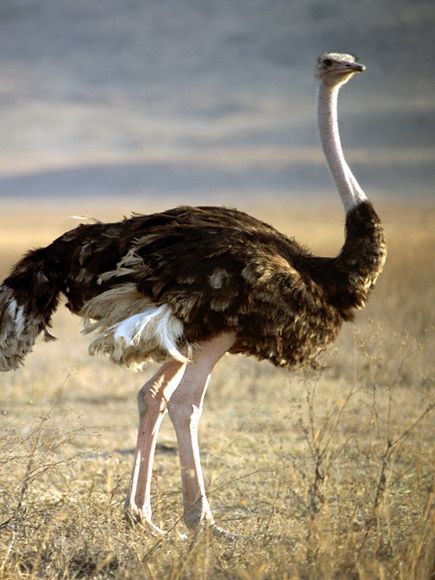
Ostriches develop into sexually older when they are 2 to 4 years old; females older about six months previous than males. The kind is iteroparous, with the mate time beginning in March or April and conclusion for a time by September. The mate practice differs in dissimilar environmental region. Territorial males typically jeer and use added sound to state success above a harem of two to seven hens. The victorious male will then be allowable to variety with all the females in an area, but will single form a match up union with the leading female.
The cock performs with his wings, broken wing beats, until he attract a helper. They will go to the mate region and he will uphold solitude by heavy away all intruders. They browse until their behavior is synchronized, then the feed become derived and the procedure takes on a ritualistic manifestation. The cock will then excitedly flap alternate wings again, and starts poking on the earth with his check. He will then violently flutter his wings to representatively clear out a nest in the filth. Then, while the hen runs encircle roughly him with lower wings, he will breeze his head in a twirl action. She will drop to the land and he will mount for copulation.
Ostriches are oviparous.
The females will arrange their fertilized eggs in a single communal nest, a simple pit, 30 to 60 centimetres (12–24 in) deep and 3 metres (9.8 ft) wide, scraped in the ground by the male. The foremost female lays her eggs first, and when it is time to cover them for incubation she junk more eggs from the weaker females, parting about 20 in most bags. Ostrich eggs are the biggest of all eggs (and by extension, the yolk is the biggest solitary cell, though they are actually the smallest eggs comparative to the size of the adult bird.On average they are 15 centimetres (5.9 in) long, 13 centimetres (5.1 in) wide, and weigh 1.4 kilograms (3.1 lb), over 20 times the weight of a chicken egg. They are silky cream-coloured, with thick bullets patent by little depths. The eggs are incubate by the females by day and by the males by night. This uses the coloration of the two sexes to escape recognition of the nest, as the plain female blend in with the rub down, while the black male is almost untraceable in the night. The incubation period is 35 to 45 days. Typically, the male defend the hatchlings and teach them to feed, even though males and females assist in education chicks. The endurance speed is low for the hatchlings, with an regular of one per nest current to maturity. Predators comprise hyenas, jackals, various birds of quarry, and vultures.
Ostriches reared entirely by humans may not through their courtship behavior at other Ostriches, but toward their person keeper.

Rheas


Description
Rheas are large, flightless birds with gray-brown plumage, lengthy legs and lengthy necks, alike to an ostrich. Males of R. Americana can reach 1.50 metres (4.9 ft), and weigh up to 40 kilograms (88 lb). Their wings are big for a flightless bird and are extend while running, to act like sails. Different most birds, rheas have only three toes. Their tarsus has level tableware on the front of it. They too amass urine discretely in an growth of the cloacae.
Personality and flock
Rheas be apt to be still birds with the omission life form when they are chicks or when the male is looking for a mate. During the non-breeding time of year they may form flocks of among 10 and 100 birds, even if the smaller Rhea forms lesser flocks than this. When in risk they flee in a zigzag route, utilize first one wing then the other, comparable to a wheel. For the period of reproduction time of year the flocks fracture up.

Duplicate

Rheas are polygamous, with males courting among two and twelve females. After mate the male builds a nest, in which each female lays her eggs in turn. The nest consists of a easy scuff in the view, craggy with grass and plants. The male incubate from ten to sixty eggs. The male will employ a bait structure and place a few eggs exterior the nest and forfeit these to predators, so that they won't attempt to get inside the nest. The male may utilize another subordinate male to hatch his eggs, while he fined another harem to create a second nest. The chicks give forth inside 36 hours of each other. The females, in the meantime, may move on and mate with other males. While helpful for the youthful, the males will arraign at any apparent threats that move toward the chicks counting female rheas and human. The youthful reach full mature size in about six months but do not strain pending they arrive at two years of age.